
New Delhi [India], September 24: India’s startup ecosystem continues to expand, but raising capital remains a significant challenge for many promising businesses. A startup may have an experienced founder, a strong product, paying customers and an attractive market, yet still struggle to convert investor interest into funding.
The reason may not always lie in the quality of the business itself. Gaps in financial preparedness, governance, documentation, fundraising strategy and due-diligence readiness can all influence how smoothly an investment process progresses.
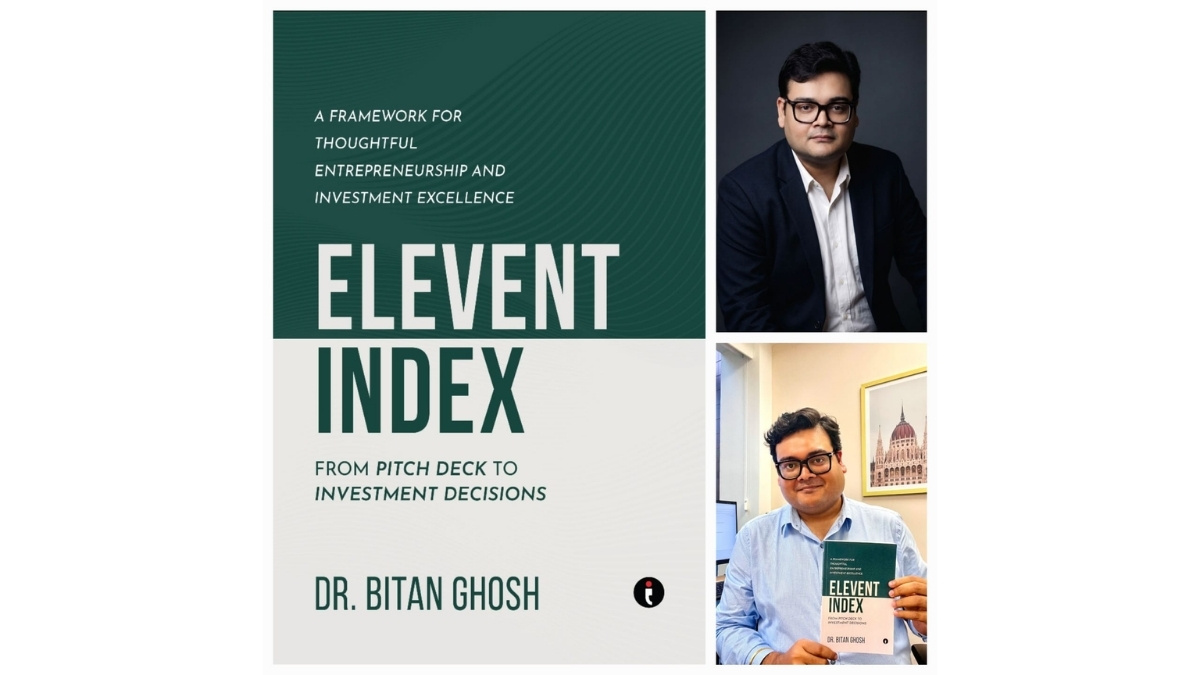
Dr. Bitan Ghosh’s book, Elevent Index: From Pitch Deck to Investment Decisions, explores this gap between building a promising startup and becoming genuinely ready for external capital.
Why Do Good Startups Struggle to Raise Capital?
Startup fundraising is often associated with a compelling pitch deck, ambitious projections and strong storytelling. Investors, however, may look considerably deeper. Financial strength, market opportunity, customer traction, business model viability, competitive positioning, governance, legal preparedness and operational capability can all form part of the investment assessment.
A promising business can therefore possess strong investment fundamentals while still being inadequately prepared for the fundraising process.
This distinction is important because the two situations require different responses. Weaknesses in the underlying business may require strategic or operational intervention, while weaknesses in fundraising preparedness may instead require better documentation, financial organisation, governance or transaction planning.
What Is the Missing Link?
Elevent Index separates startup assessment into two principal areas: Investment Quality and Funding Readiness.
Investment Quality examines the underlying strength of the startup across eleven dimensions, including founder and leadership strength, market opportunity, product and innovation, business model viability, financial strength, competitive positioning, customer and growth indicators, governance and compliance, operational readiness, investment and exit potential, and future sustainability.
Funding Readiness examines whether the organisation is adequately prepared to approach investors and navigate a capital raising process. It considers financial readiness, legal and governance readiness, fundraising strategy, due-diligence readiness and transaction readiness.
The distinction allows founders and investors to examine two related but fundamentally different questions: whether a startup represents a credible investment opportunity and whether that startup is actually prepared to raise capital.
How Can Founders Apply It?
Founders can use the framework as a pre-fundraising diagnostic. Before approaching investors, they can examine their business fundamentals and assess whether essential financial records, cap tables, material contracts, intellectual property documentation, forecasts, governance records and fundraising materials are appropriately organised.
This helps distinguish between different types of problems. Weak customer economics, for example, may require changes to the underlying business model, while incomplete documentation may primarily require better fundraising preparation.
The objective is to identify these gaps before they emerge during investor scrutiny, when unresolved issues can delay due diligence, create additional questions or complicate the investment process.
For founders, this changes the preparation process from simply asking whether the pitch deck is ready to asking whether the company behind the pitch deck is ready.
What Are the Three Elevent Index Outputs?
The framework produces three connected outputs:
Investment Quality Score (IQS): Assesses the underlying quality of the startup as an investment opportunity.
Funding Readiness Score (FRS): Assesses the organisation’s preparedness for fundraising, due diligence and the investment process.
Capital Readiness Score (CRS): Integrates Investment Quality and Funding Readiness, with the framework assigning a 70% weighting to Investment Quality and 30% to Funding Readiness.
Put more simply:
IQS: How strong is the underlying business as an investment opportunity?
FRS: How prepared is the startup to raise capital?
CRS: What does the combined picture of investment quality and funding preparedness look like?
These scores are intended as structured assessment tools rather than predictions of future startup success. The framework is designed to organise investment analysis and support professional judgment, not replace it.
What Can Readers Gain From the Book?
For founders, Elevent Index can turn the broad and sometimes ambiguous challenge of fundraising into a more structured assessment process. It can help identify areas requiring attention before investor discussions and formal due diligence begin.
Investors can use the framework as a common vocabulary for examining startups across multiple dimensions rather than relying disproportionately on a small number of visible indicators. Incubators, accelerators and advisors can similarly use the framework to discuss investment quality and funding readiness more systematically with the startups they support.
The book also provides assessment tools, scorecards, red-flag references, sector perspectives, a worked example and methodology related material intended to help readers understand how the framework can be applied in practice.
Importantly, the approach does not suggest that startup investing can be reduced entirely to numbers. Entrepreneurship remains uncertain, and investment decisions inevitably require experience, interpretation and judgment. The scores instead provide a structure within which those judgments can be examined and discussed.
Why Does Capital Readiness Matter?
The book addresses a question that entrepreneurs can easily overlook: being a good startup and being ready for capital are not necessarily the same thing.
A polished pitch cannot substitute for weak business fundamentals. At the same time, a fundamentally strong business can encounter avoidable fundraising friction if its financial records, legal documentation, governance processes and transaction preparedness are not sufficiently developed.
This is where the concept of Capital Readiness becomes relevant. By bringing Investment Quality and Funding Readiness together, the framework attempts to provide a broader picture of a startup before or during the capital raising process.
For a founder, this can help identify whether the immediate priority should be strengthening the business itself or improving the organisation’s preparedness to approach investors. For an investor, the distinction can help separate weaknesses in the investment proposition from weaknesses that may primarily reflect preparation.
By connecting Investment Quality, Funding Readiness and Capital Readiness, Dr. Bitan Ghosh’s Elevent Index: From Pitch Deck to Investment Decisions offers founders, investors and other startup ecosystem participants a structured way to examine where a business stands before capital is committed.
For entrepreneurs asking, “Why am I struggling to raise funding despite having a good business?”, the book therefore points toward a more actionable question:
“What needs to be ready before my startup approaches capital?”
Elevent Index: From Pitch Deck to Investment Decisions by Dr. Bitan Ghosh is available on Amazon India.
Buy Elevent Index on Amazon India
If you object to the content of this press release, please notify us at [email protected]. We will respond and rectify the situation within 24 hours.